Getting designs approved

Many studios treat council as a black box that happens after the pretty pictures. We treat approval pathways as work you can understand — what is being lodged, why, and what may still be open.

What approvals actually involve

In plain terms, two lines often run in parallel or in sequence — and they answer different questions.

Your project may need one or both. We do not promise outcomes — we make the pathway and responsibilities legible before you commit scope.

Planning track

Development consent

Land use and planning policy.

Does the proposal fit planning rules for the site — use, height, setbacks, overlooking, heritage and the like? This is where controls from the LEP, DCP or equivalent matter, and where conditions may be placed on what can be built.

Building track

Building approval

Construction and compliance.

Can the design be constructed safely and in line with the building code and referenced standards? Drawings and specifications here are assessed for compliance — often with certifier involvement — rather than for “do we like the look of it”.

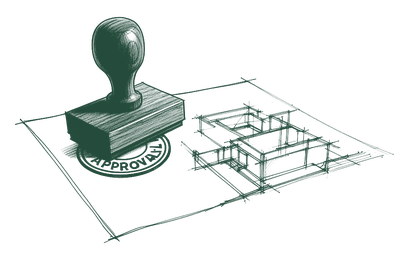
Diagram of a planning-approval track and a building-approval track running in parallel toward a finished house.
Concept illustration · Not a client project

Submission experience you can ask about

Approvals are not a separate magic service — they connect to how the brief is defined, how constraints are recorded and how documentation is issued.

Specifics are confirmed with you before anything is published as a claim.

  • Application types we work with

    Residential alterations and additions, new dwellings, change-of-use style questions where planning triggers apply, and building approval documentation packages prepared for lodgement — always within an agreed scope rather than as an implied extra.

  • How we communicate with council

    Submissions are structured so assessors can find decisions, dimensions and compliance narrative without hunting through unrelated sheets. When information requests arrive, we help you understand what is being asked, what evidence is reasonable and what may need a consultant or further design work before resubmission.

  • Councils and regions

    Planning controls and submission requirements vary by local government area, so we read the specific requirements that apply to your site rather than assuming a region's rules.

Documentation that reduces back-and-forth

Assessors and certifiers work from paper and models — unclear issues, missing levels or ambiguous notes invite another round. We align drawing structure with the purpose of the issue: what is being decided, what is nominated for builder or consultant follow-up, and what is still provisional.

That discipline runs through the six-stage process and is spelled out for documentation-only appointments on design documentation.

When the package is the product

Clear sheet structure, consistent naming and notes that say what is fixed versus provisional — so the next round is a revision, not a restart.

Common approval questions

These are process questions — not duplicates of fee or scope FAQs. For appointment boundaries, see FAQ.

Planning consent vs building approval — which comes first?
Often planning permission (or a certificate that planning rules are met) sits upstream of a building approval, but every site is different. We map which pathway applies early so design effort is not spent on drawings for the wrong stage.
RFIs and revision rounds
Requests for further information are normal, not a sign the project failed. The aim is to respond with targeted updates — revised sheets, notes or supporting documents — rather than resubmitting an entire unclear package.
Consultant inputs and timing
Structural, energy, bushfire or other specialist reports may be required before an approval can progress. We identify those dependencies when constraints are understood, not at lodgement day.
What is in scope for the designer
Lodgement, authority liaison and post-lodgement responses are defined in your proposal. If you need us to speak with council on your behalf, that is agreed explicitly — approvals are not a silent add-on.

Unsure where your project sits?

Describe the site, what you want to build and any correspondence you already have with council. We can talk through a sensible scope — including whether submission support belongs in the appointment.